“To claim influence is to say that you are good enough to absorb what you need from a writer, and to spit the rest back out”
‘Lessons from Angela Carter’ by Anne Enright in Attention: Writing on Life, Art and the World (2025)
Previously, I confessed some frustration with the public’s fixation on a writer’s daily routine. But trying to pin down where ideas come from, and how they form, mutate, and repel or envelop or bastardise literary influences – I’m there fast as small-town gossip.
Some writers try to avoid reading fiction while working on a novel, for fear of being subconsciously influenced by another writer’s style. I confess, while writing my first novel, I went through a Cormac McCarthy phase, denying my characters any internalisation. It didn’t work, obviously. I’m not Cormac McCarthy and will never be. But when I’m writing a novel, I devour anything that relates to my own work, in terms of form or style. Any fiction recommendation my PhD supervisors offer, I eagerly and dutifully order online almost as soon as I’ve left their office. No stone must be left unturned.
So, am I good enough, as Anne Enright says above, “to absorb what I need and spit the rest back out”? Or, despite my best efforts at creating consciously, am I blindly imitating those that have come before me?
Here are the works on my shelf right now, as I work.
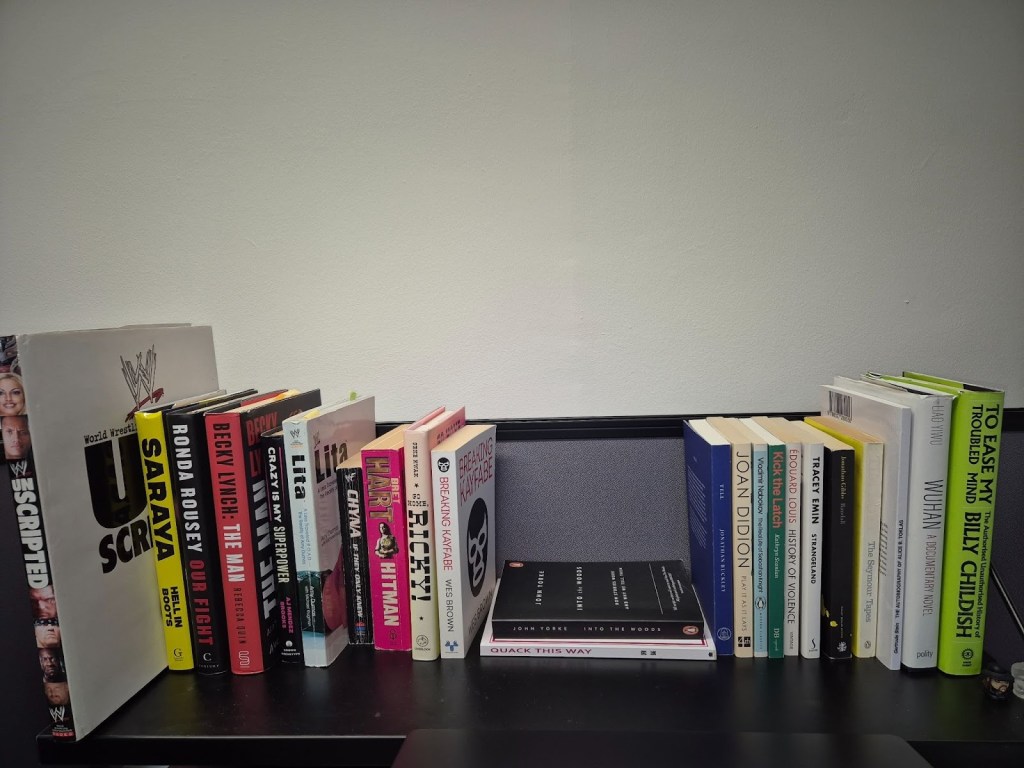
I may read a few pages before I start writing. I may reference an idea, or tone, the note a beginning leads us from, or the note a writer leaves us on. At this part of the process, perhaps I’m too close to the work, to completely understand how I’m being influenced. So, below – with more examples to come in the weeks to come – is a summary of one of these works from my shelf, and my thoughts on how it’s influenced me, followed by passages from my own work which perhaps illuminate this influence. Maybe this WIP practice will shed some light on whether I’m good enough to be fully conscious of my influences.
Becky Lynch: The Man: Not Your Average Average Girl by Rebecca Quin (2024)
American writer Gore Vidal defines the distinction between autobiography and memoir in his own memoir Palimpsest (1995): “a memoir is how one remembers one’s own life, while an autobiography is history, requiring research, dates, facts double-checked”. So, an autobiography is said to offer an unmovable truth, the star’s truth, in which they are prioritised strongly over other characters in the text. According to Smith and Watson, the autobiographical form implies less ‘self-reflexivity about the writing process’ than memoir. In this sense, The Man is your archetypal sporting autobiography. It offers no great reflection on form or process, nor, on a macro level, the market forces and company restrictions moulding Lynch’s voice.
Having said that, The Man fulfils the expectations of the autobiographical form. It’s entertaining, funny at times, an ‘easy read’. Quin/Lynch’s voice is well-captured, recognisable from her TV character. And this allows the reader to possibly experience a deeper parasocial connection with Lynch. There is access to the inner self, throughout, in both good times and bad. The overcoming-the-odds narrative is shining brightly, and the pro-wrestling fan gets the hidden revelations that we crave, namely in reflections on her relationship with fellow WWE performer Seth Rollins. The issue is, all this is so fast-paced, it appears to deny the reader all but the most perfunctory introspection. Compare this to Bret Hart’s 500-page Hitman and it’s clear Lynch is only skimming the surface.
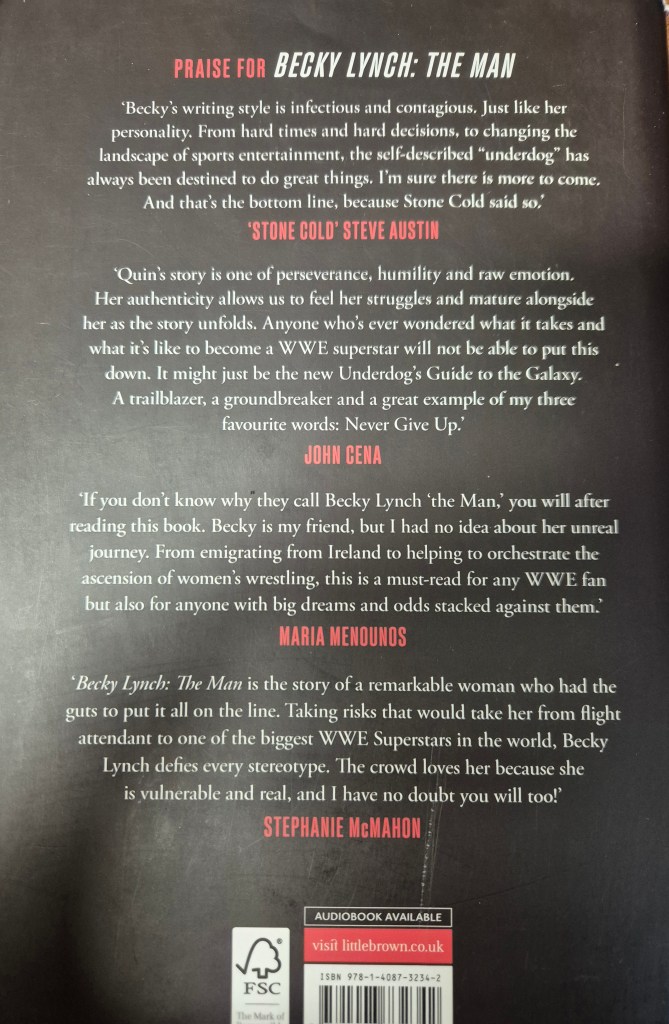
So what could I take from The Man, if my aim is to closely reflect on the biographical form, how the biographical voice is formed, and what this all means in relation to pro-wrestling’s concept of ‘truth’ (slippery, slippery truth) or ‘authenticity’? Well, I paid close attention to how Lynch and her publishers created the autobiographical form, in particular what Gerard Genette calls the ‘paratexts’ of the work. He defines these as the elements that ‘surround it [the text] and prolong it … to make it present, to assure its presence in the world, its “reception” and its consumption’. In other words, the parts around the story itself, which can instruct the reader how to read the story. As a relatively extreme example, take Dave Eggers’ best-selling memoir A Heartbreaking Work of Staggering Genius (2000), and the 48-page appendix Eggers added to later editions, once the book had already received a fair buzz. Mistakes We Knew We Were Making, as the appendix is called, discusses the impact of the memoir’s publication on Eggers’ life. Specifically, it highlights the more factual parts of the memoir versus the more fictional. By doing this, Eggers reflects on the form of memoir, highlighting the slipperiness of its truth. And he instructs the reader how to read the memoir.
With all that in mind, back to The Man. The paratext I focused most on was the ‘praise’ quotes. Who were they written by? What did they say? If I present my fictional work as validated by such quotes, though fictional, will this affect the ‘truth’ of my fictional story? How exactly does it affect the reader’s experience? I’ll leave this for you to judge…
And from my own novel:
PRAISE FOR WORK, SHOOT; SHOOT, WORK
“Trust me, the Greek Alpha’s as serious about recording his great love’s life as Cassidy was about her in-ring craft. To say they complement each other would be a criminal understatement – they’re a potent tag team about to go down in legend.”
MULTIPLE-TIME WORLD CHAMPION, “BIG MONEY” MITCH
“No one could accuse Cassidy of being one of life’s natural babyfaces, but if you’re looking for a heartbreaking story of perseverance and artistic temperament then you’ve come to the right place.”
UK PRO WRESTLING STAR, “DEMURE” DAKOTA PAISLEY
“Just when the glass ceiling seems impenetrable, Cassidy uses her most devastating challenge yet to break through in the least imaginable way possible.”
THE SUN
“This is the story of a remarkable woman brimming with authenticity, who never let go of her dreams. And it’s told by the great love of her life, who, despite their difficulties, tells her story with admirable poise. A truly groundbreaking insight into our wonderful world of professional wrestling.”
UKPW OWNER, LEO HARDAKER
“Coates’ third book sees him become a master of his craft, all the more remarkable given what he’s already achieved in pro wrestling. Without a wasted word, he brings empathy, humour and honesty to the page. And nothing is more honest than what’s at the heart of this book: truth is stranger than fiction. You don’t have to be a pro wrestling fan to enjoy this, it’s much more than a book about bodyslams. It’s packed full of secrets and will shock readers to their core.”
HEAT MAGAZINE
Next time on Influences & Inspirations… the novel Kick the Latch by Kathryn Scanlan
 Work Shoot Confessional
Leave a comment