Jade Cargill – Smackdown
Let’s talk about Cargill’s wig malfunction. This unplanned detail may seem trivial, but let me explain how its on-screen presence still forms part of Cargill’s character. For analysis of Cargill’s usual physical dominance, numbers-game antics and arrogance – of which there’s still plenty this week – see here and here.
In her article, ‘Myth! Allegory! Ekphrasis! Professional Wrestling & the Poetics of Kayfabe’ (2022), academic Marion Wrenn’s analysis of wrestling poetry offers the following, which can be applied to incidences such as Cargill’s wig troubles: “Pardlo [poet] points to the audience’s confusion and hope when kayfabe—and breaking kayfabe—is itself the spectacle.” This shows us Cargill and her wig is not so trivial. We, the audience, can clearly see what’s happening, and this, as Wrenn suggests, is where our focus is drawn. Cargill’s struggle with her wig becomes the spectacle. So what does this mean for Cargill’s character?
As I wrote in relation to Seth Rollins’ character in week 2, when planned, the “confusion and hope” and thrill the audience experiences in such ‘reality intrusions’ is often channelled back into support for the character. However, Cargill’s wig trouble was not planned – it’s a wardrobe malfunction. Yet, it still provides space for the character to be read through a lens of sympathy and vulnerability. Firstly, this occurs through the commentators. They attempt to explain Cargill’s unshifting hand to her head throughout the finish of her match as a head injury. Given Cargill’s much-stated physical dominance, this level of selling is not common to her character. So, on a kayfabe level, in the commentators’ improvisation, we read a rare vulnerability in Cargill. On a deeper level, where the audience understands pro-wrestling’s reality/fiction play, we can appreciate Cargill’s secondary labour of fixing her wardrobe malfunction on the fly, on top of her primary labour of performing in the match. The end result? Sympathy.
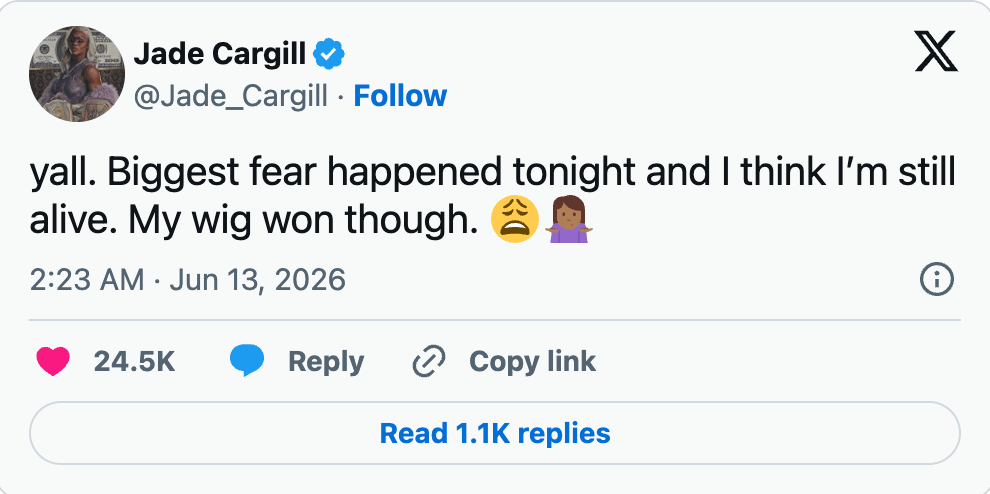
Secondly, this ‘reality intrusion’ opens the door to paratextual analysis, namely Cargill’s social media. To explain briefly, Gerard Genette defines paratexts as the elements that ‘surround it [the text] and prolong it … to make it present [emphasis in original], to assure its presence in the world, its “reception” and its consumption’. In other words, elements about the text (the text being, in this case, Smackdown) affect how we read the text. So, in the days afterwards, Cargill acknowledged her wardrobe malfunction, which can be seen as a paratext. In her paratext, Cargill shows a humour and humility rarely witnessed on-screen. And this may well feed back into her reception from the live crowd on the next episode of Smackdown. For example, maybe she gestures to the crowd that her wig is firmly glued that week, or that she’s not wearing a wig, and the crowd pops. Let’s see. But main takeaway: whatever the performer does on-screen forms character – planned or not.
Seth Rollins – Raw
After Rollins’ defeat of Breakker at the climax of last week’s Raw, the narrative pushed by the commentators is that the feud with the Vision is in Rollins ‘rear-view mirror’. Given two weeks ago, Rollins’ requested a ‘final’ battle with Breakker, we can now read Rollins as a character in control of his personal narrative, capable of fulfilling his goals. Let’s see whether this character narrative holds during the remainder of the show.
Firstly, there’s two backstage segments to read – for more on this as a distinct narrative form, see here. In his first backstage segment, Rollins gestures to the World Heavyweight Title he had to forfeit due to injury, and his past with current title holder Roman Reigns, setting this up as another part of his redemption arc. His second backstage segment sees him with new ally Montez Ford. Rollins’ willingness to once again thank Ford shows a commitment both to his repentance for former misdeeds, and, linked to this, a newfound appreciation of collectivism over individualism. When the Bloodline enters the room, Rollins speaks from a position of experience and authority in judging, albeit insulting, the Usos’ professional status. The commentators emphasise Rollins’ disrespect to thread back into his former self: “Rollins continues to start fires everywhere he goes”. This is the first clue that there are still wrinkles in Rollins’ progress narrative.
The second comes during the climax of the show. Despite assertions that the Vision is in Rollins’ rear-view mirror, Breakker’s assault denies him victory and a potential World Heavyweight Title shot. So while the commentators help to complicate Rollins’ progress narrative from backstabber to ally, his arc from unfairly dethroned champion back to champion is complicated by antagonist Breakker. Via these two narrative strands, Rollins’ control of his personal narrative and goals – namely, that via his new trustworthy, collectivist self he will once again be World Heavyweight champion – is called into question. Another obstacle for the hero to overcome on his journey towards redemption and self-mastery.


Leave a comment