Welcome, reader, to week 10 of my year-long WWE characterisation project. In this series, each week I read the characters of Seth Rollins and Jade Cargill. I offer ‘cold’ analysis based on what’s presented to us on-screen, plus any relevant paratexts, such as social media. In doing this, I try to avoid pro-wrestling fandom traits of fantasy booking and criticism of booking decisions. I am solely interested in the different ways character is presented to us, and how character arcs emerge.
When we get to Summerslam, which will mark roughly 1/4 of the way through the project, I’m going to start plotting character arcs through graphs and charts. I will reflect on the character journeys undertaken in relation to the WWE’s different narrative techniques. More on this in weeks to come.
This week, while Rollins and Cargill appear on Raw and SmackDown in multiple segments, I’m going to offer only a short summary of these appearances as they mainly feature repeated character tropes. Instead, I will focus on analysis of their premium live event (PLE) matches, in particular how their fighting styles feed into character development, and how commentary instructs us as to these styles.
Seth Rollins
Raw
First up, Rollins has a confessional segment in the form of a sit-down interview. This setting within the O2 Arena – with collections of CDs, records and books behind Rollins – invokes the intimacy of the private sphere, and thus the confessional mode. What’s important in the content of this interview is Rollins again acknowledging the Street Profits’ role in helping him the past weeks, plus an admission of physical vulnerability and that some of his previous behaviour was not ethical. This plays into the most important line: “This [the steel cage match at Night of Champions] is going to tell me, and tell the world, who Seth Rollins is”. This line, combined with the aforementioned summary of Rollins’ character progression, clarifies that what’s at stake in this match is character. And Rollins speaking of himself in the third person to end this promo is no coincidence – this is an exclamation point on the importance of character.
At the climax of the show, Rollins screws the Vision (Bron Breakker and partner) out of the tag team titles. This is a show of unity towards his allies, the Street Profits. More importantly, it provokes Breakker into bringing his best and most determined self to the premium live event, Night of Champions.
Night of Champions
The steel cage sets an important context for this in-ring fight, and, therefore, what we can read into the Rollins character. The cage clearly invokes images of imprisonment, confinement. Therefore, stepping into the cage implies a willingness to face adversity, or punishment, head on. Usually, this is particularly true for the babyface while the heel may be more reluctant (though not in this case given Breakker’s character). In this instance, Rollins embodies the babyface trope of facing adversity head-on by bringing weapons into the ring, sitting on a chair and beckoning Breakker in. Once both competitors are face to face on chairs – an unusual and provocative visual – Rollins says to Breakker: “What kind of man are you? We’re going to find out right now.” This leads straight into a physical brawl, sending a clear signal – Rollins is a man who backs up his words with action.
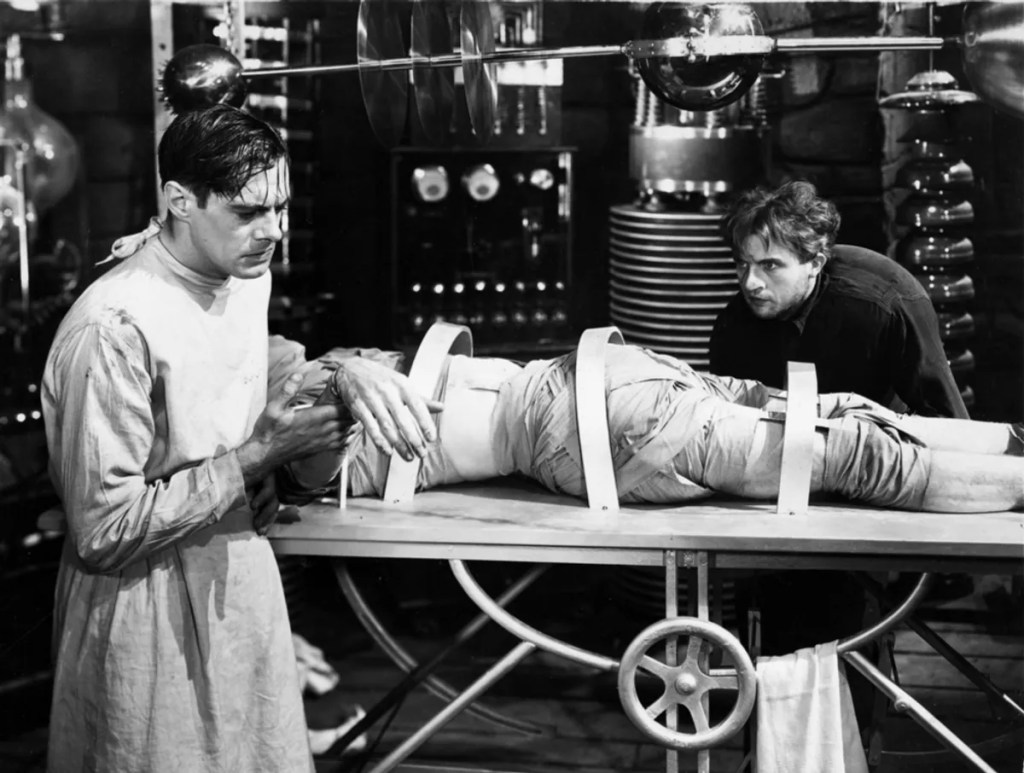
The context of the cage and Rollins as a brave babyface within it enables the commentators to mould a Frankenstein narrative. The commentators pose the question, “Does Dr. Frankenstein [Rollins] have the recipe to take down his own monster [Breakker]?”. ‘Recipe’ is an interesting word choice, given the secrecy present in the creation of Frankenstein, and thus the implication of alchemy. The commentators continue this Frankenstein narrative strongly: “Bron Breakker may not have both oars in the water, but this young man doesn’t know the meaning of fear”, and “genetic mutation”. Like the monster, Breakker is defined by physical attributes rather than intelligence. Furthermore, labelling him “the future of this industry” invokes the danger of progress, a key theme of Frankenstein. This heavy push of the Frankenstein narrative could suggest that Rollins will require both science (strategy) and magic (intangibles – talent, determination etc), to be victorious. Its presentation in juxtaposition with the early setting of Rollins’ babyface values also allows us to read Dr. Frankenstein as a babyface who must stop his monster.*
Within this context of Rollins as brave babyface Dr. Frankenstein, his fighting style is moulded by the commentators. They tell us of “months and months of frustration and anger coming out of the pores of Rollins”. These traits of anger and frustration are presented as healthy and noble rather than negative and infantile. Further, we’re told that “Seth Rollins does not know how to quit” – relentlessness, determination being typical babyface traits. But it’s in the finish where the combination of babyface values plus Frankenstein climaxes. After Breakker kicks out of Rollins’ usual finisher, the competitors lock eyes for a long while. Breakker begins to lose control in a monstrous fashion, but before he can enact his rage, Rollins delivers a rare version of his finisher, something more imaginative, more magical than usual. And this alchemy finally puts the monster down.
*Dear WWE bookers, please read Mary Shelley’s novel. Dr. Frankenstein is not a babyface. Thanks.
Jade Cargill
SmackDown
On Friday night’s pre-PLE show, Cargill screws her adversary Tiffany Stratton out of a win. The noteworthy thing here is that Cargill’s group is now being called ‘the Baddies’. This plays into pro-wrestling’s simple, clear morality play and what Roland Barthes calls a “spectacle of excess”. In other words, moral stances through physical action are so clear as to be over the top. For example, incoming acts of subterfuge are signposted to both live and TV crowds through excessive facial expressions or gestures. The group’s name acts as an extra layer of this excess. Later, when Cargill beats Stratton’s ally Chelsea Green and subsequently puts down Stratton again post-match, she says, “That’s a preview for Saturday”. This, of course, is often implied in pre-PLE one-upmanship. Saying it explicitly further invokes Barthes’ “spectacle of excess” – we’re baddies who act as baddies, and our evil intentions are clear.
Night of Champions
At Night of Champions, as previously, the commentators apply a sporting narrative to Cargill. Yet, there is a layered reading of this which complicates Cargill’s character. Here’s the key example of this:
“She knows what she wants to do, and she has the physical ability to just do it. She doesn’t necessarily have the timing. She doesn’t have the nuance of a lot of superstars. She just has raw physical ability.”
On a kayfabe level, the sporting narrative we’re offered is raw talent versus experience, physicality versus skill. This reading complements a later reference to the “maturation process of Cargill in the ring”. Depicted is a young sporting star, who must accumulate experience and strategy to add to her raw talent and physical attributes. And this allows the commentators to reframe Cargill’s recent high-profile losses as “confidence building”.
However, a deeper level of reality is in play here. Bear in mind my previous analysis from Clash in Italy. As I said then, as pro-wrestling fans, we regularly employ insider terminology and judge wrestlers on a performance level, a craft level, rather than as a kayfabe sporting competitor. With this in mind, the words “timing” and “nuance” draw attention to Cargill’s ability to cooperate with her ‘opponent’. This problematises Cargill’s character, as it suggests to us not only an inexperienced sports star, but an unskilled performer. And this in turn devalues Cargill’s physicality. We’re being told that Cargill is not yet a star, but could be.
Therefore, the karmic ending to the bout, in which Cargill loses via Charlotte Flair’s revenge, feels almost inevitable. I’ve spoken in previous weeks about the friction in Cargill’s character being the testing of her self-image against her professional results. However, here we’re being instructed that the vulnerability in Cargill’s character lies in her inexperience. It’ll be interesting to see if this results in reality and fiction aligning, and Cargill’s status diminishing in the coming weeks.


Leave a comment