Introduction
Welcome to this little peek behind the curtain of my life as a PhD researcher/novelist/freelance proofreader. With these different hats I have to wear, I would love nothing more than to put the creative side of my PhD project (a pro-wrestling-themed novel) at the centre of my life. But this isn’t easy. My attention needs to be divided, as the mortgage, bills, food and student fees need to be paid for. I don’t have PhD funding or any kind of publisher’s advance. So the aim of this article is to illustrate the struggle to maintain momentum on a creative project while attention is divided, as well as to suggest ways to overcome obstacles. Please know that this isn’t intended as some kind of self-optimisation BS.
The context for this diary being a particularly busy week is that it’s a few weeks removed from spending an intensive month of fiction-writing, in order to finish my first draft. It wasn’t easy to carve out a month’s fiction-writing time, but once in that position, working on the novel for twenty-eight days straight without other distractions, I could find and maintain momentum. Words came quickly. I was feeling the story, meaning it remained with me away from the page. Ideas for deepening the story emerged from everyday life on a much more frequent basis. But as a result of not working for a month, I took a full-time work contract for July. At the same time I must also put the finishing touches to the first draft of my novel, in order to show my PhD supervisors.
Diary
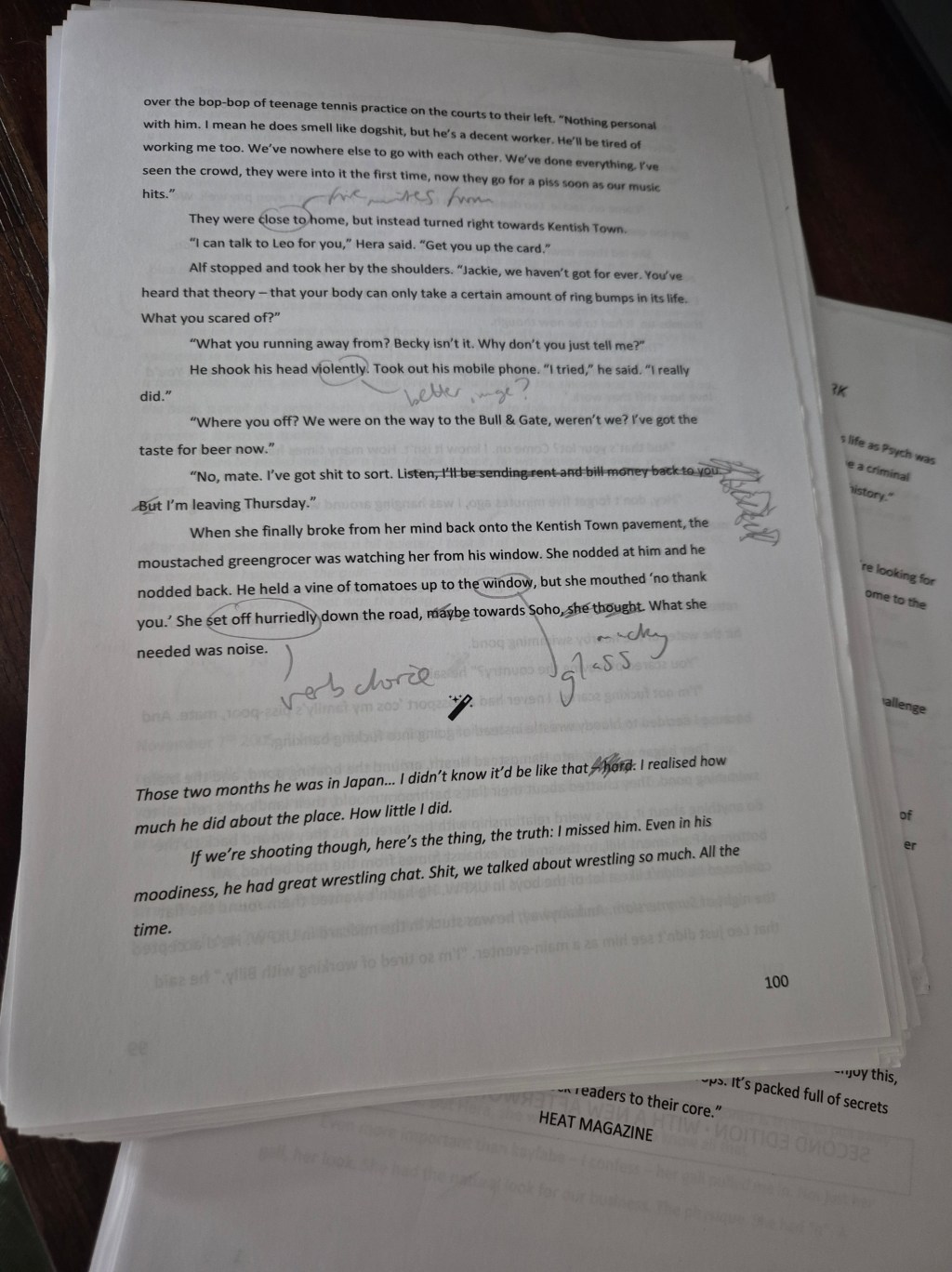
Monday: I visit a friend in London, but on the train home I edit the novel via a full read of a printed first draft and hand-written markups.
Tuesday: I work 9-5.30pm (paid work, proofreading press and point of sale ads) – during this time, I listen to pro-wrestling podcasts. On my lunch break, I continue an in-depth pro-wrestling conversation with another writer, which should turn into a joint article.
In the evening I continue with full read of novel.
Wednesday/Thursday: I work 9-5.30pm. In the evening I continue with full read of novel.
Friday: I work 9-5.30pm.
Saturday: I write two articles for Substack – one pro-wrestling-themed, the other you are reading right now!
Sunday: All day I implement minor changes to novel first draft.
Reflections
On re-reading and marking up – it’s a real advantage at this point to have a full first draft. Having the full narrative arc helps me to think of the text more clearly, and so maintain a stronger connection with it, even when away from the page. The process of spending these shorter bursts of time with the work, of leaving and returning again and again, becomes a little easier when editing rather than writing a first draft. For example, I wouldn’t be trying to write a completely new chapter on an evening after a full day’s work. I believe there’s still value in writing in whatever time possible (you can always go back and edit later), but writing fiction really requires my brain at its sharpest, which for me is first thing in the morning. Also, having a full print-out and being able to mark by hand offers a different experience to working on-screen. Note, it’s a good tip to use an unfamiliar font and adjust the size when doing this. That is, make the text as unfamiliar as possible in order to be as objective as possible.
On other ways to stay connected – in many ways, this is the most important part. For writing is not just writing, it’s also thinking. I often say that most of my good ideas don’t come when I’m at my desk, with the work. They come when I’m away from the page, thinking about the work. So I seek to keep the subject of my novel towards the front of my mind. Whether it’s podcasts, or TV, or general conversation, these connections are vital. Maybe this is something like walking a small puppy on a long lead. You might be worried but you accept you need to lengthen the lead, give the puppy some space. As long as you can still feel the lead taut, that you and the dog are still connected, you feel reassured. But as soon as they’re out of vision and the lead goes slack, you need to run after it to check it hasn’t been mauled by a bigger, more aggressive dog. In the case of the work, it’s not in danger of a mauling, but there is a danger of losing all momentum, of having to battle to regain this momentum. And if all momentum is repeatedly lost and regained, lines of thought can become muddled, and the novel could become disjointed, inconsistent, confusing to the reader. Ideally, for me at least, all lines of thought need to be tied off, before I then shelf the work for a period of time, with the goal of finding fresh perspective.
So, that’s just some brief reflections on this part of the novel-writing process, particularly within a PhD context. If you have any other strategies for staying connection to creative work when life gets in the way, I’d love to hear them!


Leave a comment