Hello reader! This is week 15 of my year-long WWE Characterisation project. A little reminder, what you can find here is ‘cold’ analysis based on what’s presented to us on-screen. I am solely interested in the different ways character is presented to us, and how character arcs emerge. A reminder that on Wednesday I will be publishing a column summing up findings and reflections from the first quarter of this year-long project.
Seth Rollins
Raw & sitdown interview with Jackie Redmond (YouTube)
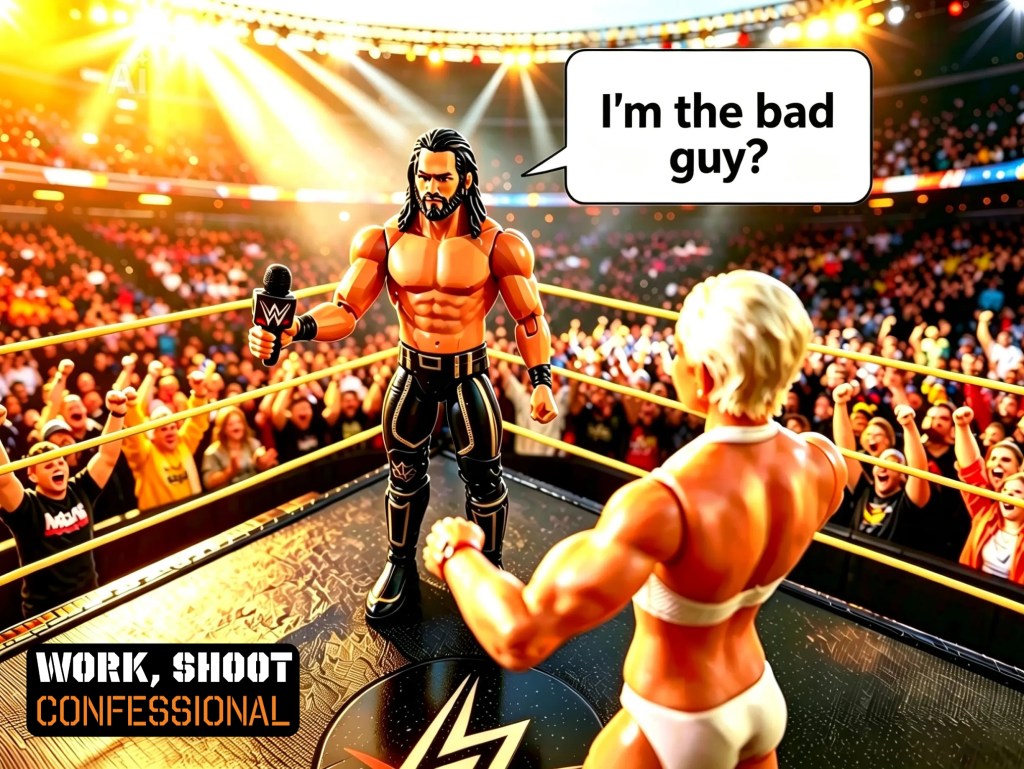
When Rollins meets adversary Roman Reigns face-to-face in a main event promo, we see similar themes from Rollins’ feud with Bron Breakker. This suggests character continuity – consistent preoccupations born in Rollins’ inner self. The first consistency comes in Rollins positioning himself as a provocateur, willing to play mental games with his adversary. He says to Reigns, “Guilty, guilty. You’re right, I’m the bad guy … When it comes to you and me, I’m the bad guy.” In the second consistency, he re-frames any morally dubious past and present behaviour as necessary for his character’s struggle towards success. Here, he positions himself as an embodiment of the American Dream: “People like me, we gotta grind, we gotta hustle, we gotta survive to get ours.”
A sitdown interview published on the WWE’s YouTube channel mid-week further illuminates these character consistencies. During the interview, an open, friendly Rollins is complimented by interviewer Redmond: “I love how candid you’re being”. This instructs the viewer to value his performance of introspection and self-knowledge. Taken as a whole, this approach from Rollins further allows the character to re-frame his past actions within a hero’s journey; he is not speaking of his past behaviour without remorse, but showing a willingness to examine it. Ultimately, as on Raw, his past is all part of his struggle, his ‘hard work’ and grind.
In another show of character consistency, Rollins explicitly seeks an end to his story with Reigns, as he also did with Breakker. There’s a pursuit of closure. This nods towards psychoanalysis, and is another way of suggesting his character is gaining in self-knowledge.
Before I get onto SummerSlam, there’s something important to address here – the WWE’s repeated gesturing towards the chair shot (Rollins’ betrayal of Reigns) that broke up The Shield, and the insistence on recreating this image almost any time Rollins and Reigns are in the same vicinity. What does this mean for the Rollins character, as the enactor of this betrayal? Well, first the image itself: Rollins assaults an unsuspecting Reigns with a steel chair, hitting him in the back (‘stabbing him in the back’), and Reigns crumples to his knees, hanging between the ropes while third stable member Dean Ambrose struggles to comprehend what’s just happened. This image is often represented as formative for both Rollins’ and Reigns’ characters. But here, as Rollins talks to Redmond, there’s talk of a multiverse where Rollins chooses to stay faithful to The Shield – in short, this is a ‘sliding doors’ moment, not only for Rollins and Reigns but the WWE in general. Rollins admits recurring guilt and self-doubt alongside, ultimately, a lack of regret. Holding these two conflicting emotions together paints Rollins as a complex, deep character, above pro-wrestling’s usual simple moral poles. As I suggested in weeks 13 and 14 of this project, Rollins’ moral stance does not always appear stable, and he seems comfortable sitting with his darkness while required.
SummerSlam
Rollins’ entrance – featuring song, face mask and tactical vest – is a nod to Shield history, but also to his tendency to play mind games with his opponents, and straddle moral boundaries. This continues with Rollins’ cerebral in-ring style, in which the further mind games link to the self-reflection time he’s given on-screen via promos and sitdown interviews. The commentators explain Rollins’ shift from all-black ring gear towards colour as signifying his completion of a redemption arc. We’re told that for Rollins, this means reclaiming the title. But we can also read his character’s redemption in recent weeks via self-reflection, atonement and collectivism.
Rollins is ultimately defeated when Reigns refuses an opportunity to recreate Rollins’ Shield betrayal. In the aftermath Rollins and Reigns bump fists in the old style of the Shield. In the lead-up to the bout, Rollins said, “There’s part of me that doesn’t know entirely who I am and what my legacy is without that statistic [undefeated against Reigns] … I think that’s such a part of me … If we lose that, in some way, I don’t know what that does for me … I would have to figure out who I am on the other side of this if I can’t get that W”. However, it appears through his gesture of solidarity towards Reigns that Rollins has finally atoned for his 2014 betrayal. He ends the night in defeat but with his character further repaired.
Jade Cargill
SmackDown
This week on SmackDown, Cargill’s appearance involves accompanying her friends to the ring as they wrestle a tag-team match. Note that Cargill leads even when accompanying, not competing – the spotlight remains on her during the entrance. Ultimately, Cargill’s underhand interference is the deciding influence in the match, allowing her team to triumph. Afterwards, Cargill displays her usual arrogance by appropriating Chelsea Green’s call-and-response gesture, then by posing centre-ring as if the victory were her own.
The most interesting part of Cargill’s characterisation this week comes with the entrance of rival Charlotte Flair. As Cargill’s allies are taken out, she shows some fear and hesitation at having to face Flair one-on-one. And though they exchange blows for a while, soon Cargill is forced into retreat and is seemingly exposed as a coward. This seems to hark back to my Week 4 analysis where I discussed the gap between Cargill’s words and actions, how she presents herself versus what she really thinks of herself, including her inner self and all its insecurities, which are clearly difficult for the character to exhibit. It will be interesting to see how this emerges at SummerSlam – Cargill and Flair are competing, but in a multi-woman match rather than one-on-one. Will Cargill avoid confrontation? Or, in a chaotic environment, will she be able to find strategies to gain an advantage on Flair while not exposing her own weaknesses and self-doubt?
SummerSlam
First thing to note is that the commentators draw attention to Prince being the inspiration for her ring gear doesn’t appear consistent with Cargill’s character. Until now, we’ve seen little evidence that she’s the type of character to value role models or inspirations. Wearing this gear appears to gesture towards Jade Cargill the person rather than Jade Cargill the character. So this could be a minor example of different layers of reality resulting in an inconsistent or confused characterisation.
Cargill’s quick, violent opening attack on Flair serves nicely as a bookend to the climax of this match. In this climax, Cargill and Flair duel atop the ladder. They end up taking each other out, allowing Chelsea Green to win. This clarifies that experiencing strong emotions (anger, revenge, jealousy) serves as a disadvantage in competition. And this plays into the ‘sports’ thread of pro-wrestling, which fits the Cargill character, who strongly values physical dominance and championships. It will be interesting to see if and how Cargill looks to regain focus in the coming weeks.


Leave a comment