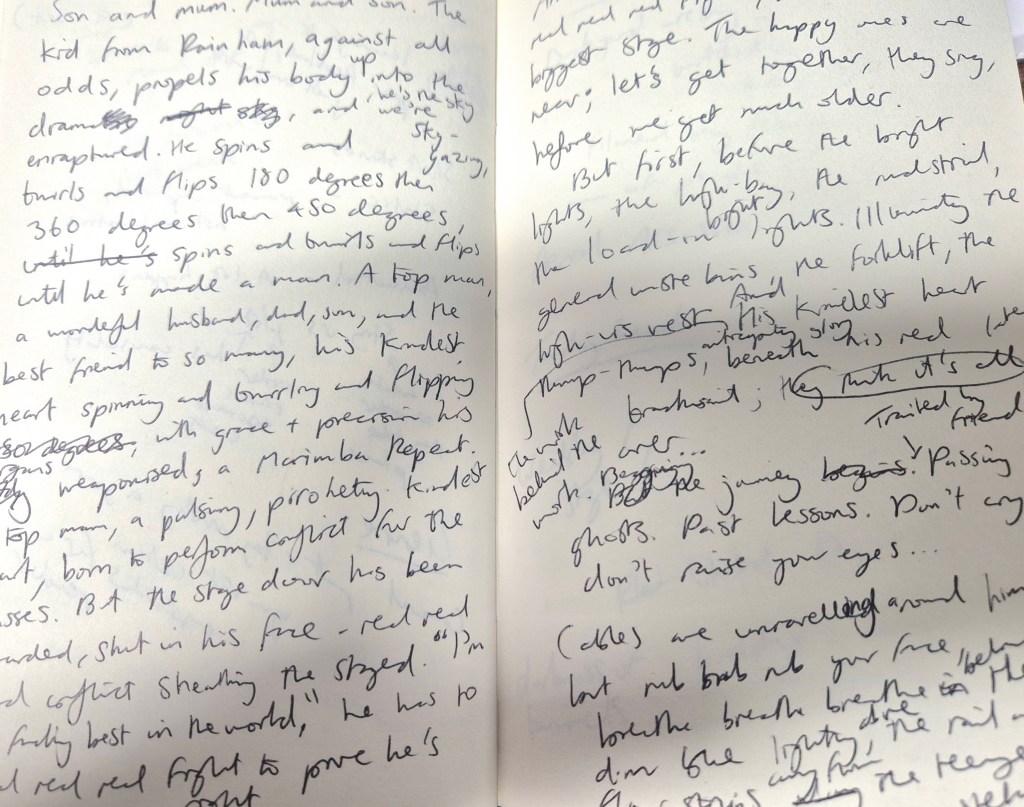
This past summer I worked intensively to complete a first draft of my novel, Work, Shoot; Shoot, Work, which comprises the creative element of my PhD project. I took myself off for a solo writing retreat, worked on it every day for a month, and achieved my goal. It was invigorating. And that feeling continued throughout the whole summer. I held onto an important state for a writer (depending on the stage of their process): keeping my emotions at the surface. I do have some things going on in my personal life that may have contributed (I’m not going into that here), but, more importantly, I feel that an immersion in the craft has allowed me to experience art with more emotion and sensitivity, and that has fed back into my work. I’m going to lay out the practices and art that have helped me to achieve that state, but first let’s think about the role emotions play in creative writing.
‘Write hot, edit cold’
Ah, the old creative writing cliché (one of many). And, as you become further entrenched in the craft of fiction writing, maybe in an educational or workshop setting, it’s the ‘editing cold’ that is prioritised. After all, that’s what workshopping, or any kind of feedback, is – using the ‘writing hot’ as a launching point, but always gesturing ahead, towards the redrafting. So, we soon gain an understanding of what ‘editing cold’ involves: moving towards specificity, stripping back to make space for the reader, re-structuring, ‘killing our darlings’, among other things. But it’s often assumed that ‘writing hot’, or writing with emotion, is second nature. It’s about speed, freedom, exploration, leniency. Our inner child. We can all do that, right? Thing is, I find the more I know, the less free I feel.
While writing my first novel straight after completing my Creative Writing MA, I felt anything but free. I could still vividly hear my tutors’ advice as I typed (nothing to do with their teaching style – purely my own anxieties/crippling urge for perfection). Each morning before I got to work on my own novel, I took notes on works I admired. How did such and such a writer survey long periods of time? How did they move from the iterative to the singulative? How did they use transition words such as ‘but’ or ‘however’? To get variation of cadence down to a science, I counted words in sentences. And the result of all this well-intentioned, objectively useful study? Writing that was, deep down, mechanical, stiff, fearful. Yet, this time round, I feel excited, curious, playful. Though I have a lot of work still ahead of me, I believe this surface emotion is present in my writing. So, below are a few experiences and practices that have combined to take me to this state:
Fiction writing every day for one month
As I have written about elsewhere, it is a privilege to be able to do this, and certainly it’s rarely possible for me, and many others. But this year I carved out the time and money. Exclusively working on a creative project every day gifts momentum to the work, but also a general excitement and curiosity about life, which then can feed back into the work itself. Plus, of course, there’s the buzz of achievement at completing a draft. What’s important is not that the work itself feels complete, but that the completion of one stage provides energy for the road to come.
Writing exercises
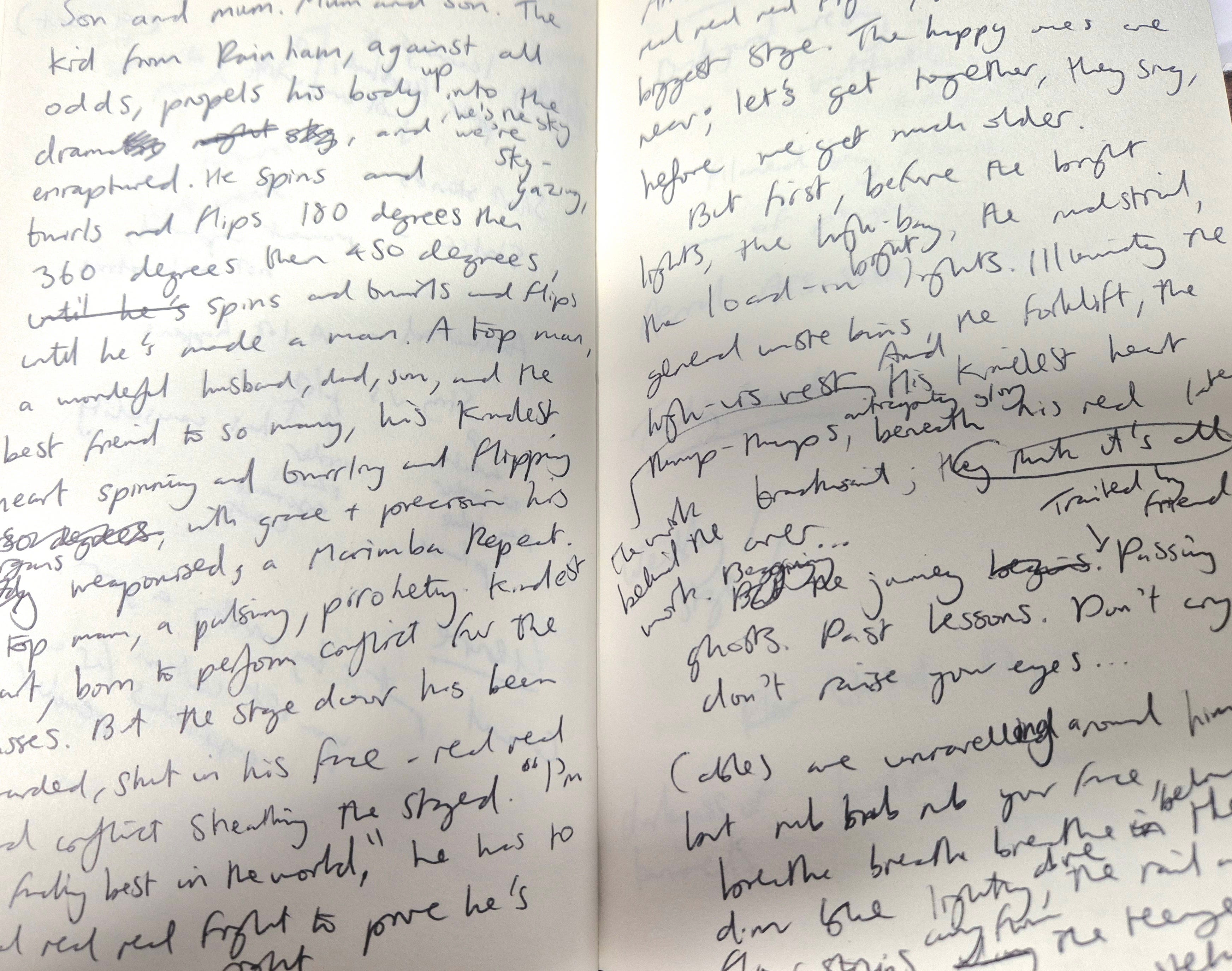
Since coming back from Spain with my complete draft, I’ve been working with my supervisor to deepen my poetic side as a writer. As I documented in this video on my writing process, I primarily love writing dialogue, and the rest of my prose tends to take on a minimal style. Along with admiring my supervisor’s academic work on pro-wrestling, I’d wanted to work with her because she’s a poet. I believed she could help me push harder to explore rhythm, rhyme, imagery and metaphor. As I wrote about here, an excellent exercise on place helped me in this regard. And now, having consistently expressed enthusiasm for writing about the watching of TV, I’ve been guided towards writing two ekphrastic (narrating, describing or reflecting on an existing artwork, in order to create a new work of art) pieces. Firstly, for my own exploration of the form, I’m writing about Will Ospreay’s entrance at All In, which I hope to share soon. Secondly, for the opening of my novel, I’m writing a similar piece on late-1970s British wrestling. I have felt a rush of energy whenever writing these pieces, and also – this might sound lame – waves of gratitude.
AEW All In – Wembley Stadium
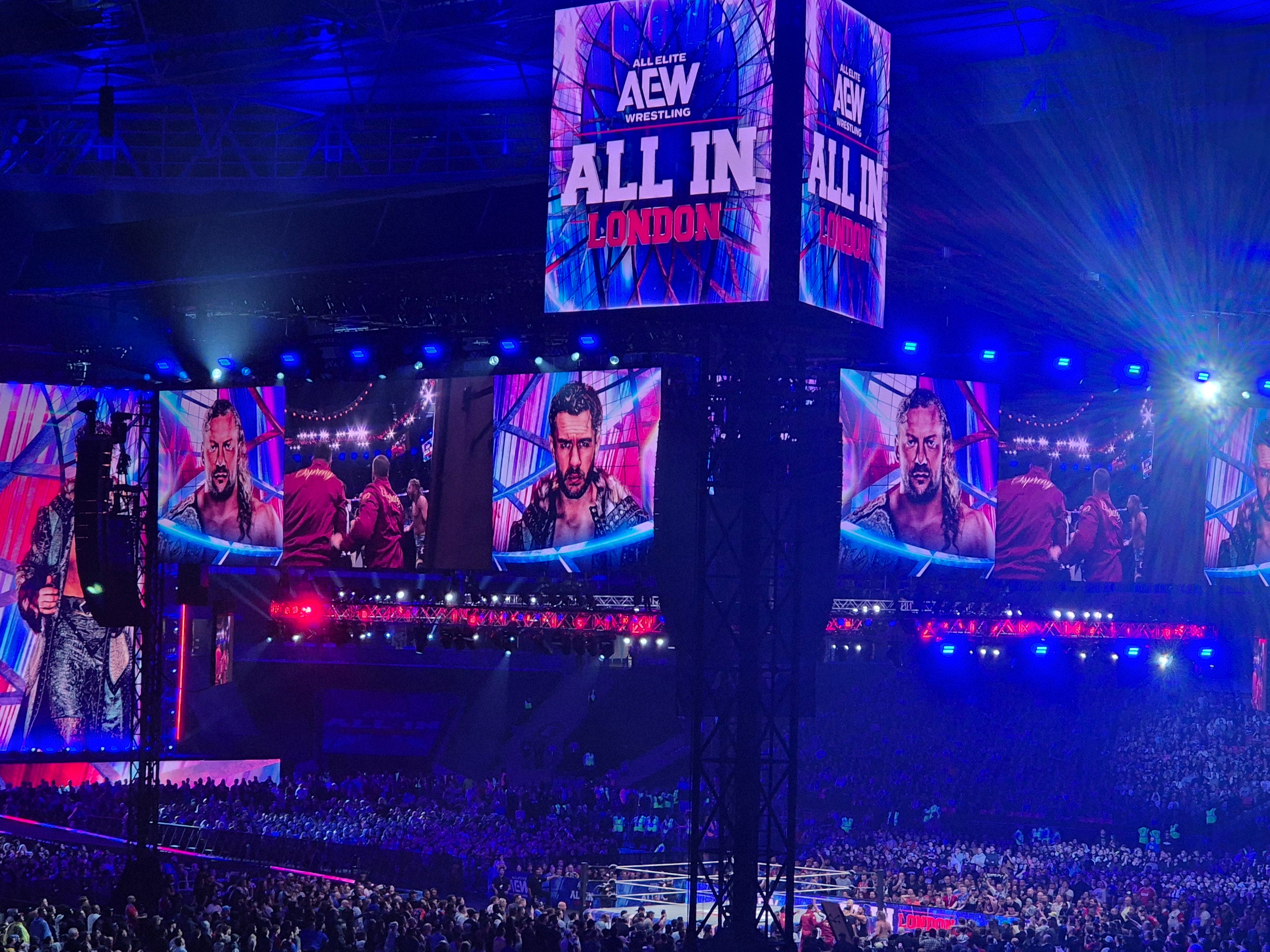
The next three entries are art I’ve experienced recently, which has fed back into my own art. The first was AEW’s Wembley show in August. I’m not going to drone on about Ospreay’s entrance yet again, but this was one of the best things I’ve ever seen in wrestling. I found it highly emotive in the way it linked music (The Who – Baba O’Riley), voiceovers and recorded images (Ospreay’s mother speaking over archive footage), and live images (the ring walk). On top of that, there was the main-event match itself against Kenny Omega. Though Ospreay getting the three and winning the belt was of course emotional, the strongest moments for me were the two one-count kickouts from Omega in close proximity. The crowd reaction. That widening of the eyes. That sense that the world’s been turned on its head. I can still feel an echo of it.
One Day (2024) and Vanbur’s music
A friend introduced me to Vanbur’s music a while back. He told me it was superb, relaxing background music. And it is. I can listen to it while reading or writing. Importantly, he also told me, the music was heavily used in the Netflix adaptation of David Nicholls’ novel One Day (2024). For those who don’t know – FYI there’s also a 2011 film starring Anne Hathaway – this is a romantic drama, a ‘will they, won’t they’ story following two friends down the years as they journey towards love. It’s only recently that I’ve got around to watching the Netflix version. And I loved it. Vanbur’s music in this context provokes rush after rush of emotion. In particular, that sweet blend of melancholy, reflection and contentedness. I cried watching this show – not something I normally do. This not only signalled that my emotions were at the surface, but that they had been for some time.
Tony (2026)
This is a film about chef Anthony Bourdain’s teenage years, which I went to the cinema to watch alone. Now, I’m not saying this is film of the year, or anything too mind-blowing. But it is a very effective coming-of-age story. Structurally, thematically, character-wise, it transported me, as a man of forty-three, to a place of reflection. Of appreciation for past struggles. Of acute empathy for those still within these struggles. Again, I’m not sure I’d have been feeling so strongly about this film without my summer of creative practice.
Reflections
The picture I’m painting here is creative practice gifting an energy and curiosity that opens the door to a sensitive, deeper experience of art, which then feeds back into the creative work. A cyclical process. The cold editing will come soon enough, but for now I’m happy to sit in this place of heightened emotion.


Leave a Reply