“To claim influence is to say that you are good enough to absorb what you need from a writer, and to spit the rest back out”
‘Lessons from Angela Carter’ by Anne Enright in Attention: Writing on Life, Art and the World (2025)
Last time, I discussed Becky Lynch/Rebecca Quin’s pro-wrestling autobiography, The Man, an on-the-nose influence in terms of form given my novel is a fictitious biography about a female pro-wrestler. But for the next few in this series, I’m going to explore fiction influences, and the different ways I’ve tried to “absorb what I need” from these works. This time, I wanted to discuss Kathryn Scanlan’s novel Kick the Latch (2022).
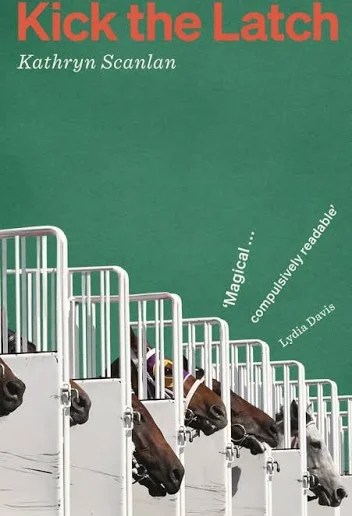
Kick the Latch tells the real story of Sonia, a horse trainer, in the first person. With this in mind, we could see Scanlan’s work as another autobiography, but in the afterword of the book, the author says “Kick the Latch is based on interviews recorded in person and by phone in 2018, 2020 and 2021. With Sonia’s permission, I transcribed those recordings and used them to write this book, which is a work of fiction” [emphasis added by me]. Here, Scanlan acknowledges, and possibly sidesteps, the post-structuralist thought that enforcing structure – a beginning, middle and end – on any story compromises its truth. While this certainly reflects my novel’s (and pro-wrestling’s) preoccupation with truth, how Kick the Latch deals with this on a micro level is what really interests me.
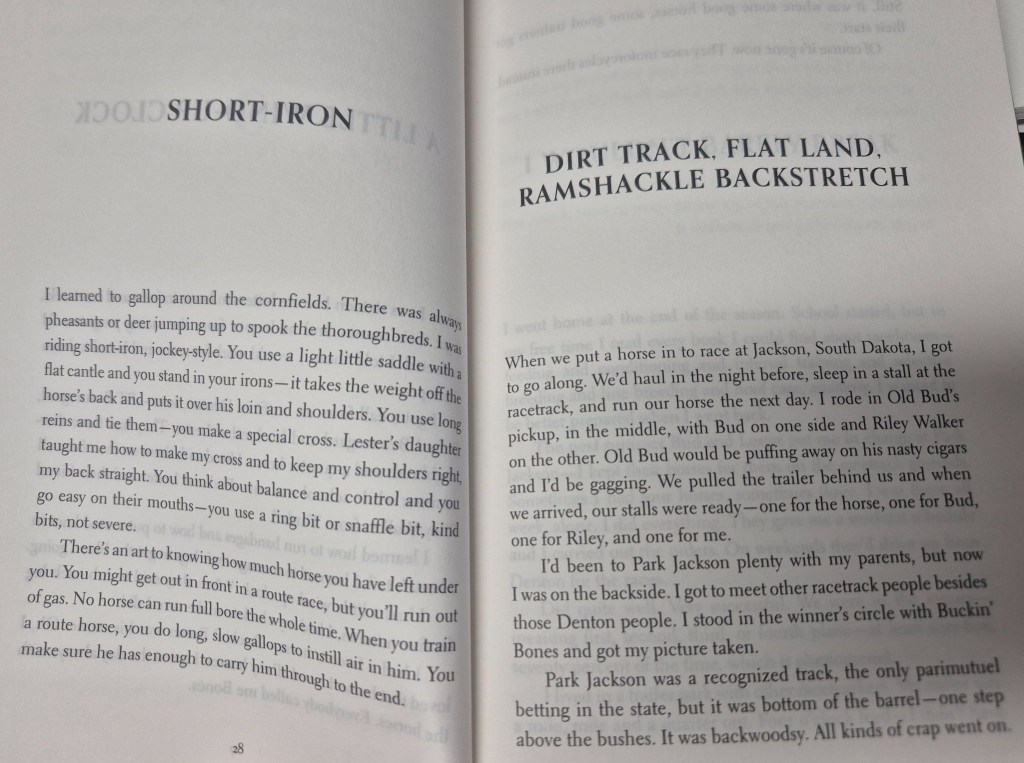
The novel is formed by 12 numbered subsections, each consisting of short episodes with their own title. These episodes each begin in media res – Latin for ‘into the middle of things’ – a literary technique where a story opens in the midst of a scene, without exposition. Indeed, Kick the Latch includes very little exposition or ‘storytelling’. This adds up to, as Scanlan says, “a composite portrait of a self”. In other words, although the macro form is fiction, this micro form may result in a more truthful portrayal of Sonia. Also, each episode starts on a new page meaning there’s a lot of white space on the page, offering the reader plenty of opportunity to pause and reflect, maybe even to re-read the episode as you might with a poem.
In my own work, I don’t always correspond to Scanlan’s style; some of my ‘episodes’ survey long periods of time, include more storytelling and take up more space on the page. As fiction writers, I believe we should allow space for the subconscious, not attempt to craft everything within an inch of its life. So, with Kick the Latch, on a conscious level I’m influenced by its episodic form, to reflect the episodic TV world which my protagonist inhabits. But on a subconscious level, I think my attraction to this form comes from a simple love of writing scenes, and in particular dialogue.
Here’s how Kick the Latch looks on the page:
And here’s an example of how I’ve been influenced in my own work:
That dinnertime Granny Welch wasn’t around, which usually meant a dinner of toast or biscuits, or maybe Cissy and Carole would share a tin of soup. But today, onto the dining table, behind the couch in the living room, Carole banged a plate featuring grey curls of mince sprouting from a baked potato. Though the potato was more raw than baked, it was a surprising effort. That’s why Carole was expecting young Cissy to put over “the dish” with more verve.
“Don’t turn your bloody nose up at my cooking,” she said, adjusting the beret she’d taken to wearing lately.
“I wasn’t,” Cissy said.
“Don’t lie to me. Only thing’s worse than turning your nose up is lying about it.”
She pulled away Cissy’s plate and set it back in the kitchen, blocking it from Cissy’s view.
“But I’m really hungry,” Cissy cried over the sound of Blue Peter playing on the TV.
“If you’re that hungry then you’ll show some fucking gratitude.”
Cissy started to cry.
Carole let her, until snot started bubbling at Cissy’s nose. “That’s disgusting,” Carole said. “Clean that muck away, and say please.”
Cissy floundered for the tissues on the arm of the couch, but Carole had followed her and now whisked away the box before Cissy could take one. Carole’s beret fell from her head and she kicked it to the corner of the room.
The TV said, “And now, how to make farmyard animals from pipecleaners.”
“Clean that muck away,” I said.
“But I need the tissues.”
“Clean it,” she yelled.
Cissy’s face reddened as she wiped her nose on her sleeve.
“Disgusting.”
Cissy slowly sat at the table, not taking her eyes from Carole. She said, “Please can I eat now? It looks very tasty. I promise.”
The knife and fork clanged as Carole tossed them onto the surface. “Fucking little bitch,” Carole said.
She studied the plate in her hands. Then she threw it at Cissy’s head. The crockery narrowly missed her temple, the hot potato thudded into her shoulder. As Carole’s shouting kicked up again, Cissy’s eyes dropped to the worms of mince already sinking into the carpet.

Happier times – one afternoon the three of them were on the beach. It was warm but not uncomfortably so. Cissy had ice cream and chocolate sauce speckled around her mouth. She was singing nonsensically to the tune from the nearby waltzers, “Meow, moo, meow, moo, moo, Jackie’s me, and Mummy, and Granny, meow moo moo.”
Carole dropped her fag butt in the moat of Cissy’s sandcastle. “Give it a rest, kid.”
When Cissy didn’t comply, Carole wrestled her into the sand. Cissy could see up Carole’s unusually wide nostrils. “You’ve got bogeys!” Cissy cried.
Carole lifted up Cissy’s vest. She pretended to hit typewriter keys on Cissy’s bare chest.
“Oh mummy’s a secretary now, finally got herself an honest job!” Granny Welch laughed.
“Sod off, you old bat,” Carole said, still typing.
Cissy screamed in delight.

The first time the TV was repossessed came when Cissy was six. There came a rapping at the door without any warning from the buzzer downstairs. Carole opened up then instantly cried, “Fuck”. As Cissy turned from Daffy Duck and peered over the back of the couch, she saw a huge black boot jamming the door. The door then swung open. There was a thump as Carole hit the carpet.
A huge man in a black bomber jacket stared at Cissy.
“It’s Giant fucking Haystacks,” Cissy said.
In the armchair, Granny Welch put down her tea and Radio Times and held out her arms, “Jackie, get over here to me.” She then addressed the man, “Do your business with speed and kindness, please sir.”
This man didn’t say a word. Instead, he bent under the door frame, then strode across the living room. As if in defiance, the TV said, “Youuu’re deththpicable!” But the man yanked the plug from the wall.
“That was Daffy!” Cissy yelled, ignoring Granny Welch’s continued pleas to join her.
Now the man was cradling the TV, comfortable under its weight although the bickering tag team of Carole and Granny Welch had struggled to set it in place only weeks earlier.
“No. Fuck off. Bring back my TV. Wrestling’s on Saturday,” Cissy said.
As the man exited the still open front door, he said to Carole, “Next time we’ll take everything.”
Carole remained strewn across the floor, pulling up the strap of her vest top. She shouted after him, “Round here everything is nothing.”
Granny Welch simply regathered her Radio Times and went straight back to circling Saturday’s schedule. After a few seconds, sensing Carole’s eyes on her, she said, “Carole, truly, from the well of my rock-hard heart, you’re an imbecile.”
Let me know whether you think I’m good enough to “absorb what I need … and spit the rest back out.”


Leave a comment