Hi reader, as promised here’s my roundup after 15 weeks of my year-long project reading the characterisation of Seth Rollins and Jade Cargill. A little disclaimer, I’m not a scientist and am no expert in creating charts/graphs. So, I got some help from AI to do this. However, all the conclusions and reflections are completely my own. I also wanted to take a second to highlight the potential shortcomings of my approach here. I’ve used my own weekly analysis to identify the most important narrative theme week to week. Obviously, this isn’t as objective as it could be, and reflects my own biases. But, bear in mind that I’m not plucking these words out of thin air; they often come directly from commentators or how opponents talk about Cargill or Rollins.
I’m still figuring out the best ways to present the findings of the project, so consider this a WIP that will likely be smoother after Q2 (you will need to zoom in on the first 2 heatmaps – sorry!).
Goal of research
Firstly, highlighting recurring narrative themes to identify character consistency, but also arcs and escalation. Secondly, identifying the narrative forms each character relies on, and looking for links between themes and forms. I wanted to offer visual representations for these two findings. Lastly, I judge these findings against a more instinctual, ‘fan’ analysis; does the data reflect how I feel on a more visceral level about the characters?
Narrative themes

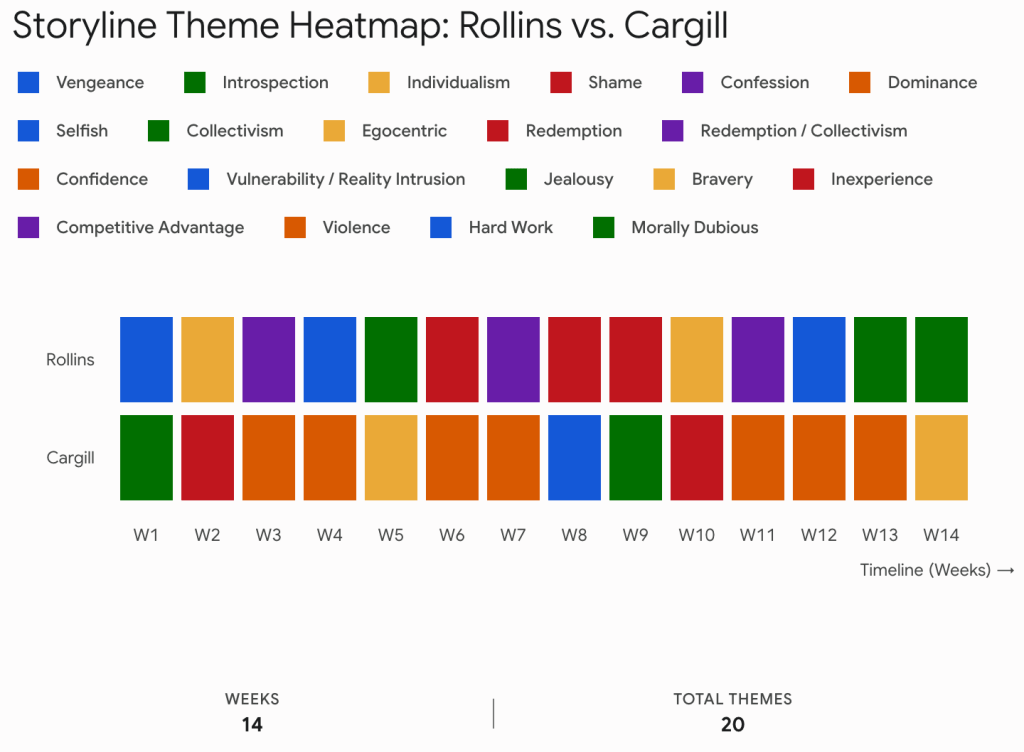
Here, you can see something like a heatmap comparing the prominent narrative themes in Rollins’ and Cargill’s characterisation. Each main weekly theme is labelled in the cell, but also I have grouped the 20 different themes in 5 wider tiers according to narrative intensity: ‘Internal’ (e.g. self-reflection) is represented by blue, then we scale up towards red for the highest tier ‘climax’. Here are some observations:
- It’s odd to see so much blue (internal) on Cargill’s side, given she’s a mainly action-based, physically intense character. I think this is slightly misleading in that the first two weeks she was absent from TV, and so I was trying hard to read between the lines regarding we might gauge from that. Similarly, in the three other blue weeks, I was trying hard to find depth in Cargill’s character given how similar her segments are each week. Of those latter three blues, only the word ‘inexperience’ was directly used on-screen by the WWE; therefore, it would be very feasible to swap ‘insecurity’ and ‘vulnerability’ for ‘dominance’ and ‘violence’, as well as accepting her absences as inconsequential (N/A). If so, the chart would look more like this:

Unfortunately, this is more reflective of how the Cargill character feels. Her character’s motivations are consistent (competition, physical dominance), but she doesn’t display a range of emotions. Her on-screen reaction to losing two big matches to Rhea Ripley was not significantly different from the times she’s been victorious.
- On the other hand, Rollins does travel up and down the emotional scale. I’d say he’s a victim of me picking only one theme per week here, as it feels like there should be a lot more blue on his side of the chart. You will see that he spends some time in red zones (high stakes/virtue) but then comes down to yellow, and then back up again. These peaks and troughs are more reflective of a narrative arc of a TV/film/novel character – i.e. a form where the narrative is self-contained within a particular time frame, whereas pro-wrestling, famously, has no ‘off-season’.
- For both characters, when the narrative settles on a high stakes theme, it stays there for a few weeks. I think this shows the WWE’s tendency to distrust the viewer, and so hammer home their narrative direction again and again.
Narrative forms
For this topic, let’s start with a similar but slightly differently formatted heatmap showing which type of narrative form (TV segment type) each character is portrayed within week by week. Unlike the theme chart, multiple forms are presented each week.
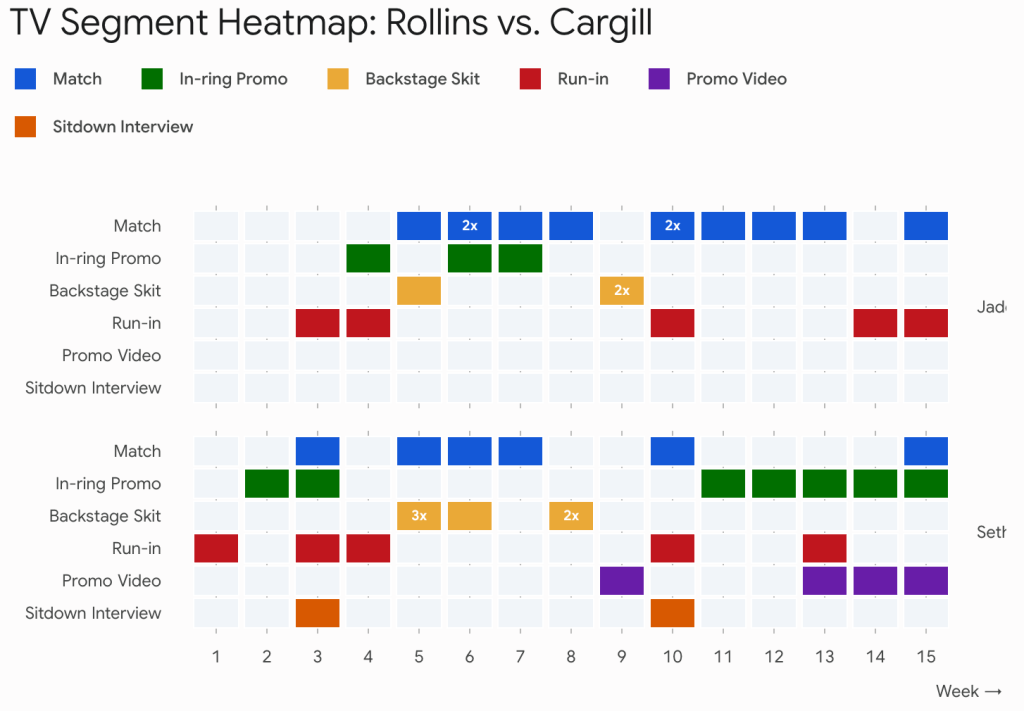
My main observation here is that Rollins’ heatmap is much more varied in colour, which reflects his character’s deeper sense of inner self. Cargill is an action-based character who doesn’t offer much introspection, and this is shown by a dominance of blue and red – non-talking segments. In three months, she hasn’t had access to the same confessional modes as Rollins (e.g. sitdown interviews). This is partly due to a babyface/heel dynamic. A babyface is more likely to be introspective, and therefore more vulnerable; on the other hand, a heel is likely to be more self-delusional, trying to hide their inner self from the audience. Another factor is an out-of-kayfabe gender bias. Both characters occupy a similar place on the card, but the WWE prioritises men’s wrestling. Consequently, Cargill is more likely to appear in multi-person, action-based segments, where more narrative ground can be covered quickly.
Here’s the bare numbers regarding the different narrative forms of each character:

To be clear, my most basic finding is a correlation between character depth and a varied narrative form. A backstage skit offers us the chance to see how a character relates to their colleagues. A sitdown interview or long in-ring promo may show us how the character really feels about themselves. In the cases of Cargill and Rollins, this finding means Cargill is a consistent but shallow character, but with Rollins it’s easier to trace arcs and a range of emotions. But how does this all feel?
Linking ‘cold analysis’ to fandom
First off, I don’t think it’s a surprise how the Cargill character feels. Without depth, and with heavy repetition in her actions (numbers-game run-ins, beatdowns etc), the character feels unsatisfactory and hard to connect to. This not only means I don’t sympathise with her (I mean, she is a heel after all), but also I don’t feel much of anything for her character. She is a hologram, a Street Fighter character, completely 2D. With Rollins, on the other hand, the tension between analysis and fandom is more interesting.
I picked Rollins for this project because though he’s always been a heavily featured superstar, I’d really have struggled to distil his character into one sentence. So I’ve been pleasantly surprised by the depth that I’ve uncovered in his character. There’s clear evidence of narrative arcs and character development. There’s logical use of his past to inform a nuanced present and future. But still, I don’t particularly care to see him on-screen – definitely not to the extent he’s featured. I will reflect on this more as the weeks go on but my first reaction is this – there’s a disconnect between his performances of regret, guilt and contrition, and how much he values the crowd singing his theme, his cartoonish laugh, his whole ‘I am a visionary…’ thing, and even the way he dresses. This might come across as me simply saying he isn’t a particularly likeable babyface, which I think is probably true, but also there’s something on a performance level – whether he’s face or heel – that takes me out of the story. Maybe his efforts to connect with the crowd are too transparent, too tropey even for 2026 WWE? Also, he’s often painted as a master of mind games but his moveset rarely, if ever, reflects this. There’s almost no adaptability – he’s no cerebral assassin. The best characters connect their in-ring style to their out-of-ring persona.
Reflections
I have one main reflection on the project so far, which I already felt but has been borne out by the data: given this is a project, with weekly columns that have an audience, I am often straining to uncover interesting themes every week and offer something with intellectual weight to both myself and any readers. To put it simply, I might be reading depth that just isn’t there. This is particularly true in the case of Cargill. Most weeks it wouldn’t be inaccurate for me to offer the same one-sentence analysis for Cargill: She and her friends enacted a beatdown, and Cargill was physically dominant. But that would make me want to stick pins in my own eyes. Whether I sacrifice intellectual stimulation for data accuracy is something to ponder as this project continues.
Thank you for reading!


Leave a comment